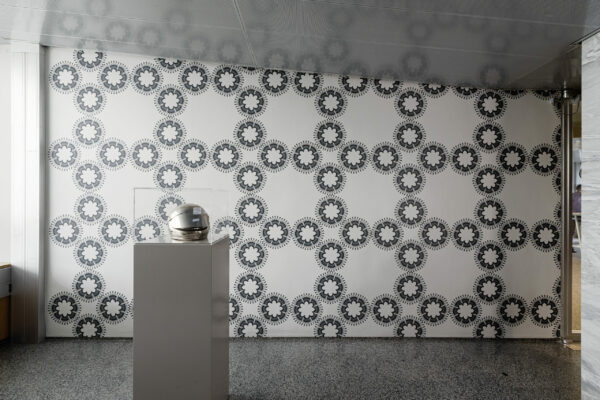
The day I killed Elvis (2020)
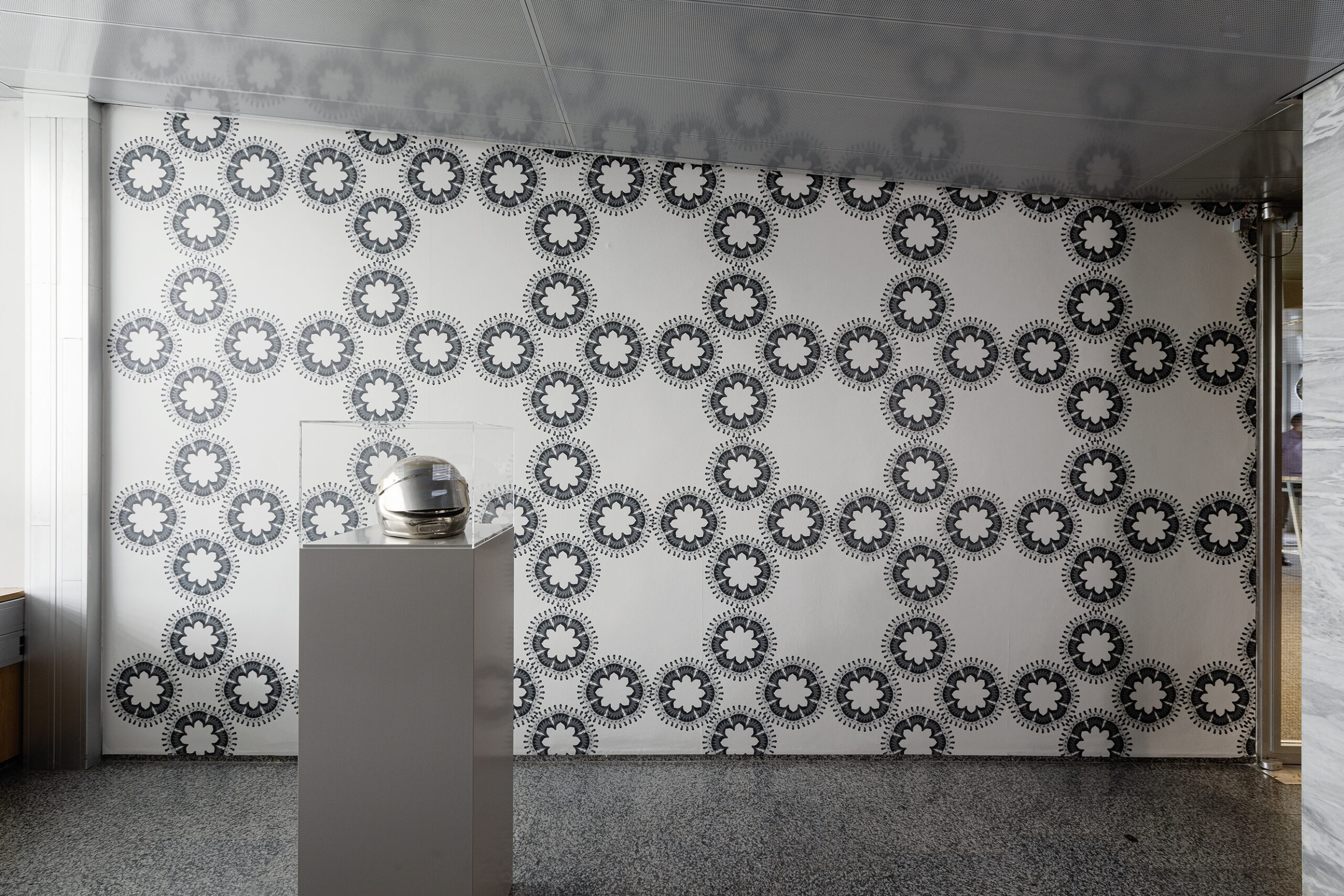

This work is the fruit of the desire to create a demultiplied representation of the infinitely repeated real without any figure ever losing its identity, each motif here being at the same time macro and/or micro, a universe in itself and another universe… Appropriating the new dimensions of the world: a world that has lost its centre, a world that replicates, clones, multiplies, decomposes and recomposes constantly… by using the fractal system, we move from geometric form to figurative form, like a grandmother’s embroidery, fabric or African hairstyles…
And then there is, in this principle of repetition and rediscovering, the idea of insistence and exhaustion: – The machine is in motion, always in motion to constantly stimulate the thought “I’m not going to repeat it to you”. 100 times! »… A form of penitence, of psalmody… To accumulate is also to contaminate, to suffocate… The eye of the beholder, trapped by an invasive obsession…
Repetition does not change anything in the object that repeats itself, but it changes something in the mind that contemplates it.
Borrowing from Andy Warhol (who borrowed and repeated a large number of images himself) and the aggressive posture of his Elvis (1963), Peter M, Mayer photographs me in turn, I will in turn appropriate to manipulate and transform in order to recover a stolen story.
This is a way of pointing out that the commercial exploitation of black music has incorporated specific signs of “blackness” than the black people themselves.
Elvis Presley took part in this commercial exploitation of blackness via the cultural industries, which benefited not so much blacks as it did whites, who performed certain traits considered characteristic of black identity and contributed to a de-racialisation of blackness.
As early as the 1950s, this mechanism of appropriation of certain black traits considered classically characteristic by the white cultural industries contributed to the ousting mostly of those who were the bearers of such signs . and the same goes for the real story of the cowboy : If, in the collective imagination, the cowboy is the ‘purebred’ American, the perfect WASP, a free and upright man, the truth is different in several respects.
In fact, the low attractiveness of the job does not encourage white people to take a job which effectively is that of a simple agricultural worker with dirty, dangerous and demeaning tasks. As a result, and contrary to the received ideas peddled by myth, cowboys are people of colour 5 who are victims of the Jim Crow laws which codify their racial segregation and prevent them from being associated with the emblematic figure of the cowboy of the Conquest of the West: Blacks, Mexicans, Metis, Indians, etc. The truth is different in several ways.
Finally, here, on closer inspection in “the day I killed Elvis”, each motif becomes a cogwheel, each little cogwheel becoming the essential part of the whole. It is a question of making movement itself a work, without representation; of inventing vibrations, rotations, twists, gravitations or dances that directly reach the mind.
“The day I killed Elvis” plays with the idea of hybridization, of mise en abyme and illusion as so many possible passages to elsewhere (next door, over there, further away, higher up…), a step, a path, a process of transformation in progress.
Die Firmensammlung der EVN AG
Die Firmensammlung der EVN AG besteht seit 1995. Sie ist eine Sammlung internationaler, zeitgenössischer Kunst und bietet die Gelegenheit zur Auseinandersetzung mit kritischen und aktuellen Positionen. Die Objekte werden von einem externen Team von Expertinnen und Experten (Brigitte Huck, Heike Maier-Rieper, Hans-Ulrich Obrist, Markus Schinwald, Thomas D. Trummer) zusammengestellt und sind als intellektuelle wie materielle Investition zu sehen. Internationalität, Qualitätsbewusstsein und Innovation verbinden die Kunstsammlung mit dem Leitbild des Unternehmens. Die Sammlung ist fester Bestandteil der Unternehmenskultur und prägt die Wahrnehmung der EVN bei Mitarbeiterinnen und Mitarbeitern sowie Kundinnen und Kunden. Die Kunstwerke werden in wechselnden Ausstellungen am Firmensitz der EVN AG in Maria Enzersdorf gezeigt.
Seit 2018 wird das Projekt „Wallpaper“ verwirklicht. Von Künstlerinnen und Künstlern gestaltete und eigens für die evn sammlung verwirklichte Tapeten werden temporär affichiert. In Kombination mit Werken aus der Sammlung wird so ein Zusammenspiel von Arbeitsplatz, Architektur und zeitgenössischer Kunst erfahrbar. In der ersten Jahreshälfte 2021 werden in Wallpaper #4 erstmals Werke und Tapeten von Sasha Auerbakh, Bar du Bois, Gottfried Bechtold, Chto Delat, Angus Fairhurst, Dr. Galentin Gatev, Marcus Geiger, Suboth Gupta, Little Warsaw, Alois Mosbacher, Elaine Reichek, Rosa Rendl, Gerwald Rockenschaub, Marianna Simnett, Jasper Spicero & Bunny Rogers, Elisabeth B. Tambwe und Maja Vukoje gezeigt
wallpaper; digital print with a digitally edited photo as original source
dimensions variable
2020
Commission 2020
Inv. No. WP_19
Austellungen
Wallpaper #4, evn sammlung, Maria Enzersdorf, 2021
Publications
Wallpaper #4, Vienna 2021, p. 3, 7–13 (s. p.)